


-
How to manage steep medical scheme increases
-
What you need to know about insuring an EV
-
How our changing family lives make financial planning more relevant
-
Costs rise as health insurance competes with medical schemes
-
At times the success of a financial plan is immeasurable
-
Why you may need money help you can’t get from AI
-
Rising policy lapses: a quick fix with long-term consequences
-
Six million taxpayers auto assessed but tax headaches remain
-
A good salary is not a debt plan
-
Two-pot system two years on – who is cashing in and why
-
I freed myself from the crude-oil curse by switching to an electric car
-
The inheritance no one talks about
-
Diversify beyond traditional ideas in a volatile new normal
-
Regulator plans to shine a light on value for money in our retirement savings
-
Five myths about writing a will
-
More heat on employers not paying over workers’ pension deductions
-
Why flying too low can crash your finances
-
What steps does the bank take when you report fraud?
-
Is your biggest client also your biggest borrower?
-
Time to rethink gender stereotypes as more women take the lead as breadwinners
-
Married or permanent life partner: why it matters in financial planning
-
Planning your financial life as a single woman and a mother
-
How can I protect myself while shopping online?
-
A financial healing journey for women: she names, she heals, she builds
-
Planning your financial life as woman, a wife and a mother
-
Don’t shun workplace benefits if you want to build a strong financial life
-
When are you actually married under customary law?
-
Time - the most powerful wealth-building tool
-
Let your bank track your budget
-
The system is rigged for us not to save
-
Two-pot withdrawals: Are we undoing our own progress?
-
The lay of the law on National Health Insurance
-
The biggest risk to your financial plan isn’t the market
-
Call to stop healthcare funding’s 'race to the bottom'
-
Mindshift required for improved health care in South Africa
-
Build your business’s resilience by retaining your best clients
-
Have no regrets: start saving while you are young
-
How credit bureaus collect a wealth of information about you
-
Is your balanced fund overexposed to these risks?
-
Is it time for value or will the AI-led growth cycle continue?
-
What you need to know before tax season 2026 begins
-
The healing journey from wounded to wealthy
-
Aspire to earning a passive income with a realistic plan
-
Why do-it-yourself (DIY) investors often need to seek advice
-
Rights for dads result in reduced maternity benefits for mums
-
Small money, big future: how investing in your 20s pays off
-
Who pays for the damage to my car from an accident that wasn’t my fault?
-
Finfluencers, AI and the new advice gap: how to protect yourself
-
Black tax: The fine line between helping and enabling
-
The electric car you think you can’t afford might actually cost you less
-
Why saving feels harder than ever
-
Don’t let past decisions trap your future wealth
-
Naming the money traumas shaping South African lives
-
How to make inheritances for overseas heirs simple, fast and tax smart
-
Umbrella trusts, beneficiary funds can help with the care of elderly dependants
-
ConCourt decision nullifies contracts couples sign after customary marriages
-
What I wish I had known before my first payday
-
Insurance shows up in real-life odds of thriving after a cancer diagnosis
-
Tax certainty for unit trust, retail hedge fund investors
-
The five hidden struggles of black tax – and how to take your power back
-
A quiet change that makes a big difference to small businesses
-
JSE’s concentration of large shares crowds out diversification
-
Why investment managers are turning to unlisted markets
-
Why diversification still matters, especially when one market is winning
-
Stay ahead of the class on fees and school extras
-
Where to focus when markets are volatile
-
Boom or bust: navigating AI in the markets
-
Why your manager probably lagged the market last year
-
The R15m exemption and why timing your business sale matters more than ever
-
The “quiet” financial wins: boring habits that outperform clever ideas
-
Understanding money wounds and their impact on our financial lives
-
Budget gives taxpayers a little breather
-
VAT threshold relief for small businesses and contractors
-
What true loves share without losing each other
-
Money anxiety in a world that never switches off
-
Financial blind spots you should try to avoid this year
-
The hidden cost of cheap financial advice
-
Are funds out of fashion? Should you invest directly in the market?
-
Separating after decades: coping with grey divorce
-
Betting on the right financial strategy
-
2025’s lessons in retirement income planning
-
Are insiders behind SARS eFiling hijackings?
-
Understanding how financial planners are paid
-
Watch out for dangerous financial advice from finfluencers
-
Leveraging social media to sell overseas
-
How you can build trust, wealth and harmony as a couple
-
How safe are my personal documents in the cloud?
-
Tweak your existing investments only if it furthers your goals
-
Is pet insurance worth it?
-
What to do if you have a big life and disability cover gap
-
Sports betting: wager or wise strategy?
-
Experts urge Muslims to plan for Shariah-compliant estates
-
How financial projections can secure small business funding
-
Curiosity – A key ingredient for financial health
-
Where there’s a will there’s a way
-
Strategies for effective wealth transfer
-
The big four financial decisions
-
Unintended consequences of tariffs could see US falter as market darling
-
Emerging markets set to benefit from shift from west to east
-
Make sure you sign your will with a pen
-
We could all retire better if …
-
Your savings pot can boost your financial position or cost you dearly
-
Will an inheritance affect my income protection payments?
-
Should you diversify across managers with different investment styles?
-
Failure to increase VAT threshold burdens small businesses
-
Expect tax certificates for cryptocurrency transactions soon
-
Double or nothing: double down on marketing your small business now
-
The architect, builder and repair man of your financial house
-
Insurance lessons from the ombuds
-
Keeping up with appearances - the wealth drain
-
Inside a cyberattack: a small business owner’s lessons from the frontline
-
Your insurance policy is not your maintenance plan
-
Mastering your money: seven key principles to keep cash flowing
-
It is tax season again - what should you look out for this year
-
When the seas are rough, repair your nets
-
Are you betting on US equity markets continuing to outperform the rest of the world?
-
Building financial confidence starts when your children are young
-
Understated expenses may explain why so many can’t afford repayments
-
The power of investing early and how to catch up if you are a late starter
-
Saving on medical scheme contributions for young adults
-
Who pays my medical expenses when I am in a road accident?
-
Treasury - A fancy word for the cliché “Cash is King”
-
Can you be overinsured with funeral policies?
-
President to appeal NHI challenge in ConCourt
-
Factors to consider when purchasing a retirement home
-
Risk rating creeps back into healthcare cover
-
Who will SARS target for an additional R800 billion in tax?
-
Use your entrepreneurial mindset to scale business amid political uncertainty
-
Connection – The fuel that drives the engine of financial advice
-
Credit regulator’s new guidelines bring relief for financially distressed consumers
-
The hidden price tag on your dream home: What banks won't tell you
-
A case study of challenges faced by SMEs in South Africa
-
How investors can be at peace amid market chaos
-
The future of investing: broader exposure without platform fees
-
Does your password protect your savings and investments?
-
The insurance lesson from a stolen phone at a cricket match
-
Clarity – The cornerstone of financial health
-
Multi-asset managers balance the risks to earn above-inflation returns
-
A smoother investment ride may enhance your returns
-
Revised budget will take R28 billion from us in VAT and income tax bracket creep
-
The dangers of falling for the AI market hype
-
Don’t make assumptions when it comes to providing for your minor children
-
SA equity funds moving back up average in return rankings
-
Ways to log your business trips for a tax deduction
-
Family business as usual in unusual times
-
Could we still see a hike in VAT when the budget is tabled?
-
Ground rules for students funded by the bank of mom and dad
-
Mistakes people make when asking for a salary increase
-
The will from hell – why professional advice is essential
-
The wisdom of not mixing business with pleasure
-
If you work abroad as an SA resident you may enjoy a tax exemption
-
Adulting gets easier when you know how to go about saving and investing
-
Ways to manage withdrawals from a living annuity
-
How you can get financially healthy
-
Five new year’s resolutions for a better financial life in 2025
-
Tax lessons we learnt in 2024
-
What we learnt from the markets in 2024
-
Small business lessons we learned in 2024
-
Why disability and severe illness policies are often so difficult to understand
-
Medical scheme networks can save you if you follow the rules
-
Dezemba is here
-
Path of least resistance to NHI: a 4% tax for healthcare free-riders
-
Are you getting retirement benefits counselling early enough to ensure you retire in comfort?
-
Why some members didn’t get savings pot withdrawals quickly
-
Stay balanced this Black Friday
-
Protect your income when you need it most
-
Franchises better positioned to succeed
-
Discretionary investments - your safety net for unexpected costs
-
New unit trust categories make it easier to find funds investing only in SA
-
Get some tax advice before you work your way around the world
-
Don't worry about the world, just save enough for your retirement - Fink
-
South Africans pay R40 billion for denied medical scheme claims - are you one of them?
-
How to spot a fake financial services company
-
Why are passive funds more popular in the US than in SA?
-
Your brain may need to be managed when it comes to money
-
Say no to (savings) pot
-
Legislation to support people living with dementia is still missing in SA
-
If you have minor children, be sure your will has these provisions
-
Pre-authorisation does not mean your scheme will pay your bills
-
Even after death: Costs. Costs? Costs!
-
Use the two pot system wisely and reach all your goals
-
How an enterprise and supplier development programme could help your SME
-
Why procrastination costs you twice
-
Life insurance pays, but only by the rules
-
How profit and purpose are enmeshed in investing
-
Are you avoiding making a plan for your retirement?
-
Small steps, big results: building wealth on any income
-
You, SARS and your duty to declare and pay tax
-
Don’t believe FX trading sites’ get-rich-quick hype
-
The tricky job of managing a living annuity through retirement
-
Two pots: Insufficient funds, tax and other hurdles facing members who want to withdraw
-
How you can live a rich life
-
Two-pot retirement system: why advice is so important
-
Offshore remains best return target while local risks should be managed
-
It's a wild world – there’s a lot of bad out there so beware
-
Is it time to give money its rightful role in your life?
-
Digital tools help small businesses master their money
-
Schemes get costlier as reform takes back seat to NHI
-
Why life cover is crucial for young families
-
Why schemes will contest the NHI Act now that it is signed
-
Play to win: the five-step process to winding up an estate
-
Two-pot retirement system: don't just focus on the cash
-
Employers pay arrear retirement contributions after shaming
-
Can’t get no satisfaction? It is getting easier to complain to an ombud
-
Do these financing models suit your business?
-
Don’t be a fool this April
-
A small business survival kit for tough economic times
-
Swix indices on the way out as JSE simplifies benchmarks
-
Diversify your investments as managers disagree on global equity outcomes
-
Expect multi-asset fund returns to diverge further in future
-
10 traps to avoid with buy-and-sell agreements
-
Keith Engel: only one way to stop average tax rates rising
-
More tax from you will plug the hole in the national budget
-
Effective tax planning saves SMEs time and money
-
Six financial planning tips for DINKs
-
Is love enough to bridge a money gap?
-
Tax year-end alert: Have you maximised your tax deductions?
-
Expect inflation-beating returns amid a noisy year in investment markets
-
Palesa Dube's lessons learnt as an entrepreneur
-
What happens to your retirement savings when you emigrate?
-
Savings hacks: Four New Year’s resolutions for new entrepreneurs
-
Living annuity drawdown rate is personal
-
Investing: Should you DIY, take advice or something in between?
-
Don’t be a victim of investment fraud - be vigilant all the time
-
Small business, big decisions: mastering the art of financial decision-making
-
The personal finance lessons we can all learn from 2023
-
Active ETFs have arrived in SA – should you care?
-
One of your most important financial decisions is the partner you choose
-
Two pots – don’t bank on getting access to your money in March
-
How to get creditworthy when you don’t have credit
-
Three top financial habits of successful entrepreneurs
-
As citizens of the world, South Africans need more specialised advice
-
Enjoying the holiday season without a budget blowout
-
Minimising the hidden retirement cost of maternity leave
-
Greater need for fairly priced pensions
-
10 tips for a bulletproof business plan
-
Tweaked two pot system likely to be delayed
-
Can money play a spiritual role in your life?
-
How to deal with medical scheme contribution increases and benefit reductions
-
When life cover starts costing an arm and a leg
-
How you can recoup some expenses for learning difficulties
-
How to choose the right capital structure for your small business
-
How much equity exposure will ensure your retirement income grows?
-
Unlocking financial freedom in seven micro steps
-
Challenges at the Master of the High Court for deceased estates
-
Planning your money around your life
-
How financially literate are you?
-
How small businesses can master financial planning
-
A special reminder to women to consider the “what ifs”
-
With a little knowledge and confidence, you too can be a great investor
-
Too many choices may be increasing your anxiety
-
The pitfalls of investing in buy-to-let property
-
Unpacking the four-letter word: debt
-
How to make money
-
Cash flow is the key to keeping small businesses afloat
-
An increase in your earnings could kickstart your savings
-
The savings KISS - keep it separate and simple
-
The value of a financial planner
-
What should you do if you inherit a firearm?
-
Saving & Investing: Some lessons from history
-
Filing the correct tax return is your responsibility
-
How your grief case and other baggage is a drag on how you manage money
-
The new global investment reality
-
Keeping-it-simple diversification
-
Guaranteed pensions offering best rates in a decade
-
7 things you should know about the latest two-pot retirement proposals
-
You can improve your retirement income with the right decisions
-
When costs keep rising
-
Get legal help if you wish to bequeath rights to property
-
Hundreds of thousands of taxpayers hit with penalties for outstanding returns
-
Public and private health care remain broken as we await grandiose NHI
-
Retirees with multiple incomes need to carefully consider SARS tax directives
-
Employer short-paying retirement fund ordered to make good
-
New measures to stop employers from failing to pay retirement fund contributions
-
Do I need a financial adviser?
-
Home equity release: shady scheme or lifesaver?
-
Trading platforms - where scamsters love to hide and other high risks
-
Do you understand the ins and outs of your marriage contract?
-
Contributing regularly gives you the benefit of rand-cost averaging
-
When life happens … are you anchored?
-
Retirement fund death benefits aren’t a right for the nominated
-
Homeowners need to be prepared for interest rate hikes and other costs
-
Bursting the bubble and other myths about passive investing
-
Volatility sees more investors diversify with hedge funds
-
Things are bad in SA, but managers are still choosing local
-
How are Retirement Fund excess contributions treated in retirement?
-
Choosing to live child-free puts a new focus on your financial plans
-
What will bracket relief save me in tax?
-
What does the 2023 Budget mean for your finances?
-
Opposites attract but can love conquer all?
-
Do you need to buy or top up a retirement annuity?
-
What can you do if your retirement annuity is worrying you?
-
Instant wealth's allure often has hellish consequences
-
Match your new year goals to your budget
-
Look after your mind, wallet and soul this festive season
-
Christmas gifts for children that keep on giving
-
How to get good value from your medical scheme
-
Delays in winding up estates continue
-
Why you need to be alive to changes in your group life cover
-
Don't let black put you in the red
-
Should you use buy now, pay later credit?
-
Property can be a great investment until it goes pear-shaped
-
Recession looms but offshore investors’ pain may ease
-
It’s a real risk to have a large gap in your life cover
-
How to plan a career break to pursue an adventure of a lifetime
-
Focus on things that matter for your financial well-being
-
Crypto assets are now financial products – what does that mean?
-
Why social media is not the place for solid financial advice
-
Does the taxman need to know about your side-hustle?
-
The real-life financial horror story
-
How not to get scammed when you try get out of debt review
-
Beware the will that is too simple for your affairs
-
Can you claim a home office tax deduction?
-
Help your child spend their allowance effectively
-
Don't let being the nurturer disempower you financially
-
This should make sense even at age 25
-
Planning for retirement and a good chance you will live to 100
-
Take care when choosing a tax practitioner
-
It's Savings Month: just start
-
Inflation - and interest rates - will things get worse before they get better?
-
The worst investment decision you can make
-
Paying for financial advice: fees on investments or professional fees in rands?
-
Life policy and investment proceeds worth R33.5bn unclaimed
-
The tax savings many retirees miss
-
Investment markets are complicated, but you can still make money
-
Hard-earned money grows faster in a tax-free savings account
-
Get ready, tax filing season is coming
-
Finding a good manager – is high conviction the key?
-
Survive the cost of living crisis – what you need to do now
-
Balloon payments are no party
-
A deathly get-rich scheme you do not want to be part of
-
More tax on my pension – can that be right?
-
How much offshore exposure should you have?
-
The investment grass isn’t always greener on the other side
-
Keep your goals in sight as markets react to Ukraine and other threats
-
Retirement funds can invest more offshore now but many are likely to take their time
-
Learning years ahead? Take some lessons on how to lighten the school fees
-
A little relief for South African pockets
-
Retirees on more than one pension should expect more tax to be withheld from March
-
Valentine’s Day trigger a money moment?
-
Be my Valentine, and ask me anything about my budget
-
More rights for life partners, but it still pays to protect yourself
-
Watch out for penalties as tax return deadlines come and go
-
Be more mindful about your money in the new year
-
Home insurance claim rejected for wear and tear. Is that fair?
-
Investors continue to move offshore
-
How to be sure your life insurance will pay out
-
Don’t be led into holiday season temptation
-
Covid reinforces the need for income protection for shorter illnesses
-
Despite lower medical scheme increases, your cover may still need a check up
-
Scheme increases below salary increases on average, but it may still be a heavy dose
-
Finding a suitable investment - conservative or aggressive is not enough
-
New proposals could give dismal pension numbers a big boost
-
The cost of not getting advice
-
Thinking of raiding your retirement savings? Think small and think twice
-
Choosing a pension more about blending than choosing one over the other
-
Will your family finances survive the loss of a breadwinner?
-
Investors losing out on growth with fund choices
-
How to cope in tough times
-
It's a really bad time to die without a will or an estate plan
-
Beware the man-in-the-middle of your transaction emails
-
Tax return deadline looms with penalties for those who miss it
-
All you need to know about two-pots and retirement
-
Is it a good time to buy your first home – or should you wait?

Why your manager probably lagged the market last year
Laura du Preez | 10 March 2026

Laura du Preez has been writing about personal finance topics for more than 20 years, including eight years as personal finance editor for two leading media houses.





Most active fund managers struggled to keep up with the South African stock market's return of more than 40 percent last year, according to recent research released by  Morningstar.
Fund managers chose to stay more diversified and not chase the good returns delivered by a concentrated part of the market, they told the Investment Forum, a leading investment industry event hosted by the Collaborative Exchange in Cape Town and Johannesburg over the past week.
Precious metals led the charge
According to three leading equity managers, 2025’s gains were driven by a small cluster of shares, mainly in the precious‑metals mining sector, and especially gold. This created what they said was “an unusually narrow market” that rewarded concentration rather than diversification.
 “Only 21 percent of stocks listed on the JSE actually outperformed the market… The ‘South African Magnificent Seven’ — the precious‑metal miners — did 200 percent-plus, while the rest were left in the dust,” Leonard Kruger, portfolio manager at M&G Investments said.
Kruger says 2025 was a complete outlier in the past 25 years and while active managers, who look for opportunities in a much more diversified market, did not lose money, it was also hard for them to keep up.
“2025 was a cracker for the index because it doesn’t care about risk control, whereas the whole [investment] industry tries to manage risk,” Rob Spanjaard, chief executive officer and chief investment officer at Rezco Asset Management, said.
Passive funds don’t assess risk; they mirror the market. When the market becomes highly concentrated, they benefit by default, he added.
Few fund managers are willing or permitted to take the level of risk that would be required to invest as heavily in the small group of companies that drove the market last year.
Most managers lagged behind
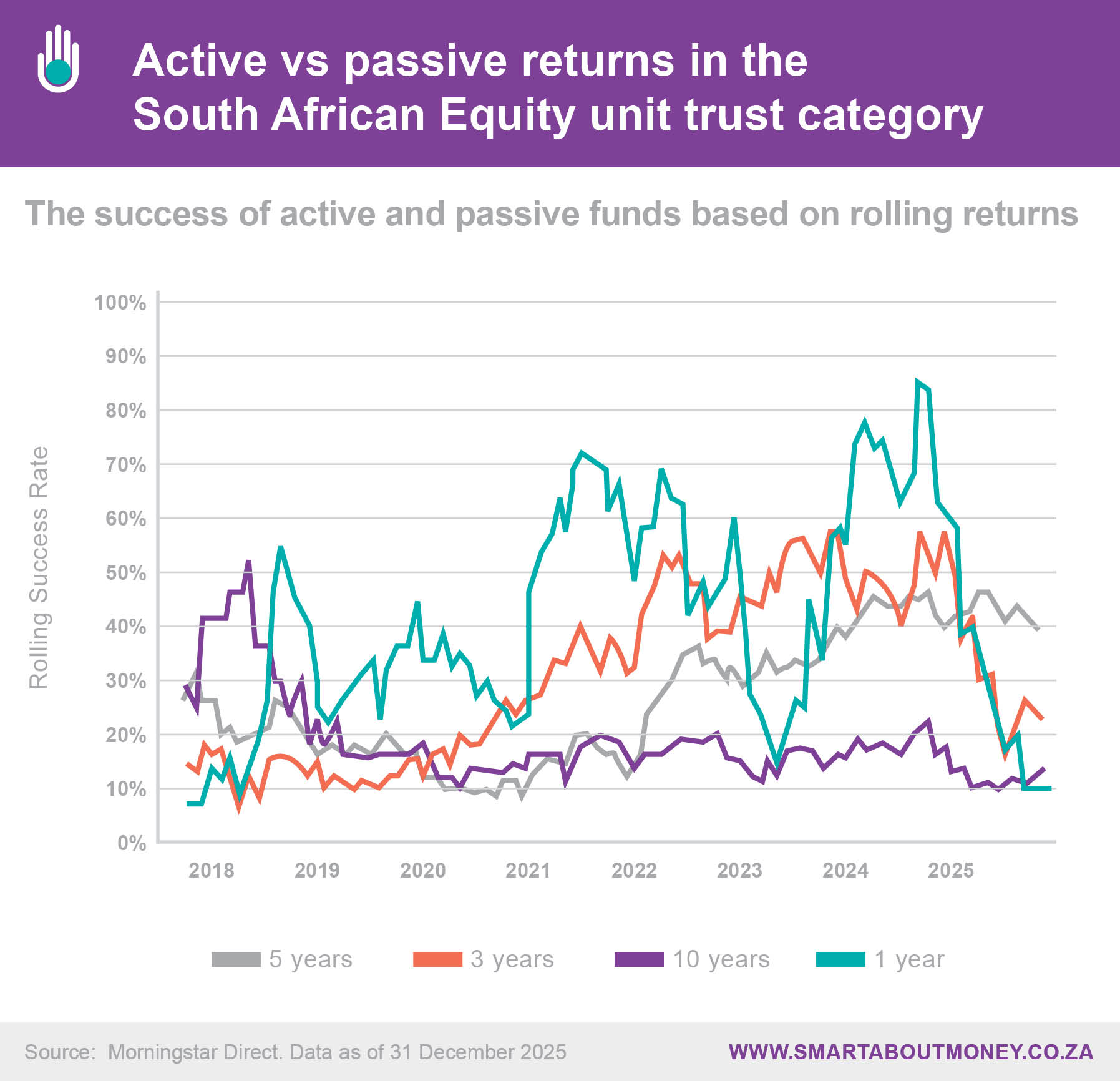 Michael Dodd, manager of selection services at Morningstar, said Morningstar’s recent Morningstar Active Passive Barometer Report showed that only 10 percent of actively managed South African equity managers outperformed the average returns achieved by passive funds last year.
The 119 actively managed equity funds achieved a strong average return of 36.4 percent while the 41 passive equity funds achieved an average return of 44.8 percent, the report shows.
| 1-year | 119 | 41 | 36.4% | 44.8% | 10.1% | ||
| 3-year | 121 | 47 | 18.2% | 19.5% | 24.8% | ||
| 5-year | 124 | 52 | 17.7% | 17.5% | 40.3% | ||
| 10-year | 124 | 36 | 10.3% | 11.6% | 12.9% | ||
| Source: Morningstar South African Active / Passive Barometer 2025 | |||||||
ACTIVE FUNDS OUTPERFORMING PASSIVE  |
|||||||
| Period | Active funds | Passive funds | Active funds Asset- weighted Returns | Passive funds Asset- weighted Returns | Percentage of active funds that outperformed passive funds | ||
These average returns are calculated using weightings in line with the amount invested in each fund (asset-weighted)
Spanjaard pointed out that in 2024, 80 percent of active managers beat the index.
Why managers didn’t chase leading shares
Wim Murray, portfolio manager at Foord Asset Management, says that the FTSE JSE All Share index (Alsi) that local passive equity funds track, reflects the fact that South  Africa is a resource-rich country. This brings greater volatility. After a year like last year when resources shares have done well, investors in index-tracking funds end up with a bigger weighting in their portfolios. However, they also face a much greater risk of the price of the shares they are heavily exposed to falling, than a year ago.
Murray said resources shares make up 30 percent of the Alsi now compared to about 10 percent for the leading world index, the MSCI World index, and five percent in the leading US index, the S&P500 index.
Mikhail Motala, equity portfolio manager at PSG, said without active management, the PSG SA Equity Fund would have done four percentage points better last year, but it would have ended the year with 15 percent of the portfolio in platinum group metals (PGMs). At this point in the cycle, you want to be counter-cyclical, he added. Index positions and moves are cyclical.
Positions differ
Dodd pointed out that Rezco’s equity fund had no exposure to resources shares. Spanjaard said the manager prefers companies that get more valuable and compound every year, like Capitec or Standard Bank.
 Spanjaard said Rezco does not see precious metal miners compounding. A chart in dollars of one of the largest gold miners, Gold Fields, shows the share went nowhere over 50 years, he said.
Motala said whilst it is true that over the past 50 years diversified miners have not compounded, there has been an inflection point – a dearth of supply of minerals, miners’ cost bases have changed and inflation is stickier.
He said PSG had been underweight in the PGM miners relative to the index in 2024 but after researching the sector it decided there was an investment case: because issues around demand related to electric cars were so top of mind, no one was factoring in an unfolding supply gap.
Murray said he agreed that the demand had been overemphasised at the expense of supply but he said Foord had a small position in resources shares because their prices were influenced by fickle retail investors who could sell out.
Spanjaard agreed saying retail investors are dangerous, weak holders of these shares making them very risky. He said managers do not know if the gold price will double or halve.
Kruger said M&G typically has not held gold but changed its view in 2022 and 2023 as there has been a change in the gold market that is underappreciated by investors globally.
He said while no one can call the gold price, he knows the valuation of a miner like Anglo Gold, that it will generate a R100 billion cashflow this year that it cannot allocate and that it will return money to shareholders. He was therefore happy to own the share.
Why precious metals performed so strongly
South Africa, as a major mining country, benefitted from a global trend last year when the demand for critical minerals surged due to global geopolitical tensions and competition for secure supplies, Unathi Loos, a portfolio manager at M&G Investments, explained.
 Loos warned, however, that while the sector is currently benefiting from strong prices in certain resources, commodity cycles are volatile. Prices can move far from the cost of removing resources from the ground, she said.
Investing long‑term requires careful risk management and not just a focus on short-term price spikes. Long-term investors should focus on where demand will be in 10 years and where prices are likely to be in 10 years. Some projects take up to 15 years to bring to fruition, she added.
Market capitalisation indices, however, will reflect price movements and the composition of the resources shares in the index will respond to commodity and business cycles as demand and supply of resources changes, Loos said.
Coal was in demand as a result of the Russian Ukrainian war, PGMs were in demand for electric cars, gold is in demand as a safe alternative to the US dollar and US treasuries, while copper is in demand for artificial intelligence, the conference heard.
Loos said while there are cycles within cycles, there is currently a structural change – the need to secure critical minerals, that is supporting higher metals prices.
What this means for your investments
Last year’s market performance and the performance of the funds that track it was exceptional, but it was also unusual. Investors should be aware that:
- Active funds will have underperformed the index
 Active funds will have underperformed the index because they were more diversified than the index.
Their role is to balance returns and risk — not to chase sector-specific booms.
- Passive funds are exposed to the commodities cycle
Passive funds may have as much as 30 percent in resources shares, which worked in 2025, but it may expose you to the risk of investment values falling if the commodities cycle turns.
Diversification remains a powerful long‑term strategy. Index-trackers may deliver over long periods but will have periods of better and worse performance, as their concentrations in different market sectors are in or out of favour.
The demand for critical minerals should ensure the resource sector continues to deliver good – but volatile – returns for South African inavestors.
Related articles
What is a financial index?
What is active investing?
What is passive investing?
What is the active versus passive debate?
What does it mean if an equity fund specialises or invests broadly?
Why should I diversify my investments?
Related hot topics
Unintended consequences of tariffs could see US falter as market darling
Diversify your investments as managers disagree on global equity outcomes
Emerging markets set to benefit from shift from west to east
Should you diversify across managers with different investment styles?
Boom or bust: navigating AI in the markets